
Alfred University Summer Ceramics, Monday July 3rd
I arrived in the studio early to begin working on a slipware bowl. Soon it was time to see In-Chin’s demo on throwing medium sized bowls, large plates, and a large jar. In-Chin at the wheel is like watching a majestic fish swim in the ocean: calm, relaxed, deft, amazingly skillful. I include a few video clips so you can see the master at work: Large Jar Part I; Large Jar Part II.
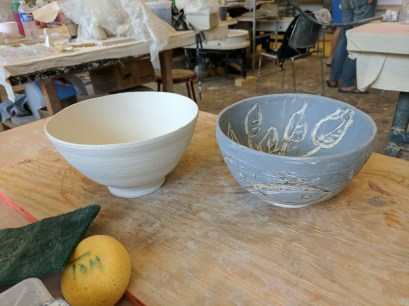 After the demo I returned to my bench to etch off the black slip from a bowl I had been working on the day before. My goal was to reveal the fish and leaf design I had painted with wax resist over the white slip using my finger as a brush. In addition to the broad-stroke effect of a finger instead of a brush, while the slip was still wet, I added texture to the white slip using a rubber brush. It’s simple, and it is certainly primitive; I hope glazing will help pull the design together into a flowing effect. I used a splintered piece of bamboo and a thick broom straw to etch away the slip. Potters are always looking for everyday objects that can be used as tools in the craft. The bamboo idea I got from Miranda Thomas, a well-known potter in Vermont, I used bamboo collected from the roadside.
In the afternoon, John Gill gave a demo on glazing. In his inimitable style he told us to first, “Ask the pot, what is it telling me? Why this? Why that?” Predictably someone in the group asked for technical details. “I’m really dumb. If the horse bucks, I get back on it. … I do not need authority, I’m just having a good time.” He said this as he cut shapes from wide blue painters tape and applied these to his pot before dipping it in a glaze. After dipping in the glaze he removed the tape-shapes revealing areas with no glaze to which he applied splotches of contrasting glazes. “Mistakes? Get used to it. Don’t throw out the baby just because it’s born!”


With the encouragement to be free to make mistakes, I started glazing the accumulated pots that had been bisqued. I started with the mugs — a clear shell glaze inside, followed by wax resist to delineate the rim. I will fire these at cone 10 (hottest kiln) reduction (i.e., starved for oxygen — resulting in reduced valence metals and salts). I glazed eight bowls some for cone 10 wood kiln and others for cone 10 reduction. Later I glazed the outside of the mugs, a plate, and two pitchers. I’ll fire the plate and two pitchers in the wood kiln. The atmosphere in the wood kiln (from the calcium oxide in the ash) will vitrify unglazed regions, plus the falling wood ash has a wonderful effect on the resulting glazed surface. Accordingly, for the pots going into the wood kiln, I left regions unglazed.

Soon it was time for In-Chin‘s afternoon lecture. He discussed some of his work, using professional video from two of his art shows as a backdrop. Regarding Korean ceramic art he says, “I am fortunate — I have a huge tradition. 5000 years and never stopped. It’s in my blood. I don’t try to copy [others, it’s part of who I am.]” He tells us that unlike Chinese and Japanese ceramics, Korean ceramics intentionally has something missing — something suggested but not fully there. He says it fits into the modern style more than the highly rendered and perfected look of Chinese and Japanese ceramics. “In China,” he goes on, “they trim the hell out of it. It doesn’t have the feeling of ‘hand.’ When trimmed at the wheel they use a very hard line, very sharp and rigid. I trim [with] very soft clay [giving a soft feeling of ‘hand’].”
When asked how he goes about selecting his clay, he notes, “If you start ‘complaining it’ you cannot do anything. Accept the clay, accept the glaze. I take what clay I have; take what glaze I have. I cannot copy [others]. I do not compete with my students or anyone else.” He goes on to describe his approach to his craft, “I live my life 100%. I follow the nature. Nature changes — what you see is changing all the time. It’s changing. I see more closer, which means I’m getting older. Take as it is. Not too seriously. [That’s] the way I live; the way I work with my students. I work a certain number of hours a day. What I do best is what I do.”
 tgholt.net
I don’t know about chemistry or science, but I sure see one deep spiritual truth in pottery after another!
LikeLike
Well spoken! I have much to learn here!
LikeLike