
Alfred University Summer Ceramics, Saturday July 1st
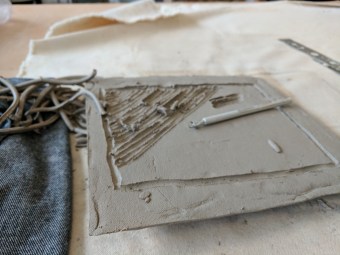
Having spent the morning reflecting, writing, and catching up with family, I only arrived at the studio after lunch. Since it was the weekend, fewer people were in the studio. I set about removing excess clay from a mold I made yesterday. Instead of the cross theme, I decided to try a circle. I am not particularly happy with it, but it’s interesting enough to continue with the experiment. Then curiously, an overwhelming fear came over me about returning to throwing. I knew I had to start throwing larger lumps of clay (> 3 lbs), but I was worried about an inability to center the clay. I put off the fear by taking time out to clean and organize my work area, all in preparation for throwing.
Centering is the first step to throwing at the wheel, it ensures that the clay is uniform and evenly distributed. If the clay is at all off center, the resulting form will be lopsided or fall apart. Any inconsistency, including a hidden bubble, will throw the clay off center. As a beginning thrower, the tendency is to fight with the clay and force it into “centered.” This can lead to frustration and many false starts, beginning over and over again, each time with a fresh lump of clay.
I divided a 25-lb bag of clay into half, and then into quarters, resulting in lumps of clay about 3 lbs each. I consciously took my time wedging, carefully making the clay uniform and avoiding incorporating any bubbles. I also intentionally took my time centering. There were no distractions, and there were no time constraints — I had all afternoon; it was just the clay and me. I thought of the clay not just as an object, but as an unformed version of what it will become. I know this sounds corny, but it helped me focus on the goal of the centering: To bring the clay into uniformity and into a place of perfect preparedness for the stretching and compressing to come.
The results were refreshing. After thoroughly wedging, I truly took the time needed to center; there was no rush. Patiently pulling up the clay into a cone and then compressing it. Each time bringing it closer to center. It was a dance this time, not a competition. It took no great strength, no fighting, just a listening patience, as the clay truly does have a life of its own. It was as if I were encouraging the clay to become centered. The added component this time (compared to my customary fighting and forcing) was a patient waiting for the clay to become centered. It felt good to be back at the wheel.


There was one lump that came off center. (Yes, I had inadvertently resorted to fighting it!) I simply took this clay off, placed it on the bench in an irregular standing arch form to dry a bit, and continued with the next lump. After an hour, the arched clay was ready to be re-wedged and thrown. At the end of the afternoon, I had eight bowls thrown, each one an improvement of the last. They say the soul of the bowl is its interior shape. I focused on this and learned through the series to control and contain the tendency to flare out too quickly. There are many lessons in clay — patience, respect for the other, listening, wise use of control, and letting go.


Tom, your experience with clay reminds me of this great quote from Eugene Peterson: “Spiritual reading does not mean reading on spiritual or religious subjects, but reading any book that comes to hand in a spiritual way, which is to say, listening to the Spirit, alert to intimations of God.”
LikeLiked by 1 person
Thank you for that! His words ring true.
LikeLike