
Alfred University Summer Ceramics, Tuesday June 27th
I am fortunate — thanks in large part to Bonnie — to attend Alfred University’s Summer Ceramics 2017 Open Studio led by John Gill and In-Chin Lee. Having arrived on Sunday evening, it’s now “day 2” of the course. Sunday evening we had a reception in the new Alfred Ceramic Art Museum (which opened at the end of last year). It was delightful to see the range of ceramic art on display — covering nearly 2500 years and representing diverse cultures both near and far. Monday was spent setting up my bench and wheel and then throwing a few pots. It takes some time to warm up to the new environment and start throwing. I started small by throwing five mugs and a pitcher. Monday night I put handles on three of the mugs, leaving the other two for today. I was hoping to feel more inspired, but perhaps that will come later.
Today I put handles on the remaining two mugs and tried to put a handle on a pitcher, but the pitcher was too wet. As it turns out, it was far too heavy — i.e., the clay was too thick, thus it was not drying very fast. This is my first attempt at throwing a pitcher, so I’ll try to make the next one lighter.
John Gill gave the morning demonstration — using his free-style hand- building technique to construct forms from slabs of clay. He’s famous for his use of color and a free-flowing form. Here is a link to some of his work. His demonstration focused on a hand-built cup and a tea-pot, all in his inimitable style. His demonstration was the beginning of a process that will take a few days to complete.


Still finding myself lacking in inspiration, I threw a few small, 2-pound bowls — not too difficult, and then went back to throwing cylinder forms, including another pitcher. There are two basic forms of wheel-thrown pottery — cylinders and open form. Tea pots, vases, and cups are based on the cylinder whereas bowls and plates are open-form. A major difference is that for cylinders, the clay is pulled up the outside and with open forms, the clay is pulled up from the inside.
With the return to cylinders, I ran into difficulty centering and throwing, in part because I’m reusing the clay. Clay that’s been worked before is more difficult to throw, unless with much care the clay is thoroughly “wedged” (caused to be mixed) to make it completely uniform. Any presence of non-uniformity will cause the form to be thrown off-balance. Wedging clay involves slicing the clay and throwing the slices back together with sufficient force to cause some mixing of the clay. This is followed by a kneading-like process that eventually brings the clay to uniformity. Simply placing the wedged ball clay on a canvas surface for a few minutes, though, will dry out part of the clay sufficiently to affect throwing.
In the afternoon, I trimmed some bowls
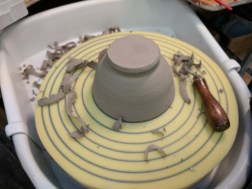
and tried to handle the pitcher again. In-Chin came over and took my carefully pulled handle, balled it up, rolled it into a long cigar and attached it to the pitcher. He then pulled it into a long handle, but I thought it was getting too thin. After he carefully attached it, he commented, “It’s too thin!” I half wished I’d attached it myself and was half glad I got to witness him attach a handle so swiftly. It takes me much, *much* longer to pull the handle, attach it, and then pull it on the form. He made it seem effortless, but for me it’s quite a challenge. I then set about trying to make the pot lighter by trimming the bottom and then scooping out facets along the side. The overall effect is somewhat primitive, but “Oh well!”
John Gill gave the afternoon lecture — a Powerpoint presentation showing key examples of his work from the early 70’s until today. It took only a minute or two describing his own work for him to become animated and “in the spirit,” in a way reminiscent of a pentecostal preacher. His style is almost dance-like, and his words poetic when he is describing the inspiration behind each piece: “You just do it like this…” he gesticulated wildly demonstrating the creation of form, “…until you’re satisfied, and then it gets “vitrified!”
During the question and answer session, he described the communal depression felt in the campus community after the debacle known as the November election. But then, he said, he became encouraged by seeing it in light of color theory. According to color theory, are three main aspects of color: Hue, Value, and Intensity. He sees Washington, D.C. as merely presenting the country with Hue. But we the people add the Value and Intensity. Put it all together, and you have Color. If we can focus on adding Value and Intensity, we can keep up our courage and live with optimism.
I close with some notes from John Gill’s question and answer session at the end of his lecture.
“All colors go together; some work harder.” This is a famous quote of John Gill, who is a master of color combinations.
In response to a question about inspiration he said, “Father art, don’t mother it! The people who receive your art can mother it.” He continued, “Any idea should be quick, easy, effortless.” As he said this he turned to the side and exhaled a poof of air to demonstrate the arrival of an idea.
“Don’t worry about making your art. There’s too much birth control in your art! It’s scary to think that you can become a parent accidentally. Ideas can be that fertile! That’s pretty cool! Exciting! Look at that idea, see what it looks like.”
“Ideas are like children. You give birth to them, care for them, but it’s not your responsibility what eventually happens to them. They take on a life of their own.”
His response to a question about technical errors — which the questioner said are prevalent, bringing frustration, occupying much of our time, causing problems, and major difficulties in our art: “If you have a kid, do you want him to be an absolute genius or just a regular person?”
 tgholt.net
Hello and thank you for these postings. I am returning to the wheel after almost fifty years and I find these delightful and inspiring!
LikeLiked by 1 person
Thank you for your feedback! Enjoy your return the wheel and may it uncover your inner this-ness!
LikeLike