
Alfred University Summer Ceramics, Tuesday July 4th


This morning work began on preparing pots for three kilns — a large wood-fired kiln, and two small kilns: a salt kiln, and a soda kiln. The majority of the space in the kiln is for In-Chin’s bisqueware, but some space was reserved for student work.


In all three types of kilns (wood, salt, and soda) unglazed regions of the pot are glazed (or vitrified) by the atmosphere of the kiln. In wood fired kilns, the ash contains oxides of calcium, which in gaseous form, react with exposed silicates on the surface of the pot to form a glaze. Similarly in salt (sodium chloride) and soda (sodium carbonate) kilns, an atmosphere of sodium oxide is produced. This occurs at the hottest point in the firing when wet salt or soda is added to the kiln. The salt is added by sliding out a brick in the wall of the kiln and throwing in the salt with the use of a metal scoop and heat-resistant gloves.
Salt glazing was once very common — it gives the earthy brown color seen in pots from colonial America and also in ceramic sewer pipes from the first half of the last century. But use of salt glazing fell out of favor in functional ware sometime in the 1800s and industrial salt firing was discontinued in the 1960s due to air pollution concerns. When the salt is heated, a caustic gas, hydrogen chloride (which forms hydrochloric acid) is produced and released into the atmosphere. Soda, although less thorough in forming a salt glaze, is preferred as it does not generate the caustic gas. In 1959, as a grad student at Alfred, Don Reitz revived the neglected salt glazing technique for studio pottery, and through the use of various metal oxides, he developed a range of colors and surface effects.
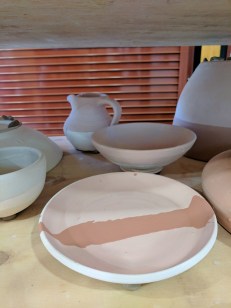
To prepare my pots for firing in the wood kiln and the soda kiln, I attached (using Elmer’s Glue) three “wads” of a wet refractory clay mixture under each pot. The wads will not vitrify, and thus they serve to keep the bisqueware from glazing onto, and adhering permanently to, the kiln shelf. I was able to fit the two pitchers in the wood-fired kiln and four bowls and a plate in the soda-fired kiln. Each piece has regions left unglazed, in order to pick up the wood fired or the salt glaze.
I tried to etch a design into the remaining white slipped bowl, but discovered the slip was already too hard to remove. Nevertheless, I did carve in a simple, brief, flower-like design. All eight bowls were placed in the bisque kiln.
In the afternoon, I set about throwing four six-pound bowls from a 25-lb bag of clay. Throwing the first bowl was unremarkable, but I ran into difficulty centering with the subsequent bowls. Throwing at the wheel feels like fishing. Sometimes the fish are biting, sometimes not. Assuming you’re fishing to eat, a good large fish is a “keeper,” while less desirable fish are thrown back. So it is with centering, I was having an off-day (“the fish were not biting”), and several forms I cut in half (“I threw them back”) to analyze where I went wrong. Fast-forward to the evening, as I was throwing my sixth and last bowl (the planned four bowls had now become six smaller bowls). Still having difficulty, feeling hopelessly stuck, and with some reluctance, I asked In-Chin for help. I did not want to admit defeat and was embarrassed with my inability to even throw a simple bowl. In-Chin immediately saw the basic problem, “You play around with it too much!” he said. He then, with the hands of a master, began to carefully redeem my bowl from its predicament. “Don’t center perfectly, just close; you will get it worked out when you pull the clay!” He noted the rough surface, “You are removing all the slip, because you play too much!” Wow, that’s what I needed to hear! I was trying for perfection. That was my problem.


In the evening, we had a Fourth of July picnic next to the outdoor kilns. In-Chin was the chef and master of the event — grilled vegetables, steak, and fish, plus numerous side-dishes prepared by students and faculty. It was good to relax and visit with others, on this national holiday. Let’s hope for the renewal of all good in our nation.
After clean up, we lit the wood kiln, and I signed up for kiln duty (tending the fire) in the morning. The firing will take about three days, followed by a long cooling process.
 tgholt.net