
Alfred University Summer Ceramics, Thursday June 29th
When I arrived at the studio in the morning, a demo on 3D clay printing was in full swing. Using the latest in robotic technology, this growing branch of ceramic art employs 3D printing to obtain unique shapes and textures (here is an example). I attended the demo only briefly, spent some time talking with John Gill as he continued to work on his pot, and took the bowls and remaining pitcher outside to dry in the wind. The rest of the morning was spent in the library, pouring over books displaying works by Bernard Leach and Michael Cardew. I scanned several of these images, so I have the images to refer to later.


In the afternoon, I joined a group tour of the Alfred Ceramic Art Museum archive. Our group was limited in size for security, and we could carry no bags nor notebooks with us for fear we might break something. 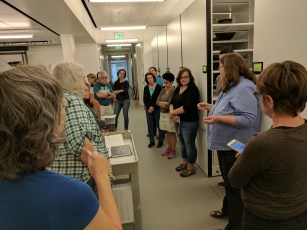 Housed in a large, brightly lit basement vault, the archive is a collection of some 8,000 works of art, many of them rarely seen, and most of them priceless. The archive includes works by previous faculty, visiting faculty, and students (many of them now accomplished ceramic artists) as well as gifts from the collections of several donors. The room is outfitted with rolling, stackable shelving units containing drawers to hold all the works of art. The objects lay on plastic foam, designed to be completely inert and most objects are surrounded by “socks” filled with small plastic beads to keep the objects from rolling or sliding. There are works from 250 BCE through 2016. Although most of the objects are American, there is a good representation from Europe, Asia, Africa, and Central and South America. It’s unusual to be allowed in the archive, as the vault is strictly off limits to the public. There were so many warnings to us about how we were not to touch anything or lean over any of the objects, with reminders of how invaluable the objects were, that I started imagining going nuts and breaking everything. It’s kind of like when you look over the edge of a sky scraper — you almost feel like you’ll be swept away, unless you take extreme precautions.


In the afternoon, John was still at work on his pot. I stopped by to chat, and I brought up the subject of Michael Cardew — knowing that John was not a fan of Cardew’s work. John said Cardew (who was British) was a “colonialist” in the sense that things had to be done in a certain way and only in that way. He was reviving 17th century British slipware and it could only be done in the proper manner — no other. When he went to Africa, where he spent much of his career, he made the natives make British slipware according to the British way. They had to make English pots to sell in England. At the other extreme, and in the current era, John Gill and the School of Art & Design at Alfred are all about doing things your own way. “Do things wrong!” he tells us. “What is it that *you* see? Express yourself (no one else)! Father art! You do not have to do it the right way; there is no right way!”
When I got back to the studio later in the evening I brought with me the rolling pin I had left still packed in the car. The rolling pin helped me instantly make new friends, as a rolling pin is currently a hot commodity in the studio, and several people wanted to borrow it. It felt good to be accepted and have happy, light conversations with some of the younger students. Age can be such a barrier — I’m not sure if it’s more on their part or on my part, but the barrier is beginning to dissolve.
 tgholt.net